How NENote can reduce documentation time by 40% in Healthcare
NENote is an AI medical scribe custom-built for the Dutch healthcare system. We developed the platform to slash administrative tasks and give clinicians more time for their patients.
March 31, 2026•5 min read
Skills used
Platform infrastructure
Product design
Full-stack Development
Industries
Healthcare

Dutch healthcare is under structural pressure. Demand is rising, staffing is stretched, and a significant share of a clinician's day disappears into documentation. Time that never reaches patients.
NENote is an AI medical scribe built specifically for the Dutch care system. It listens during consultations, understands clinical language, and generates structured reports automatically in SOEP format or any custom template a practice defines.
The product serves GGZ professionals, medical specialists, and the practice teams that support them. It is not a diagnostic tool. It is infrastructure: designed to remove repetitive, low-value work from the workflow so that clinicians can focus on what requires their judgment.
The North Solution designed and built NENote from the ground up.Product strategy, UX, frontend, backend, AI integration, and compliance architecture.
Platform overview
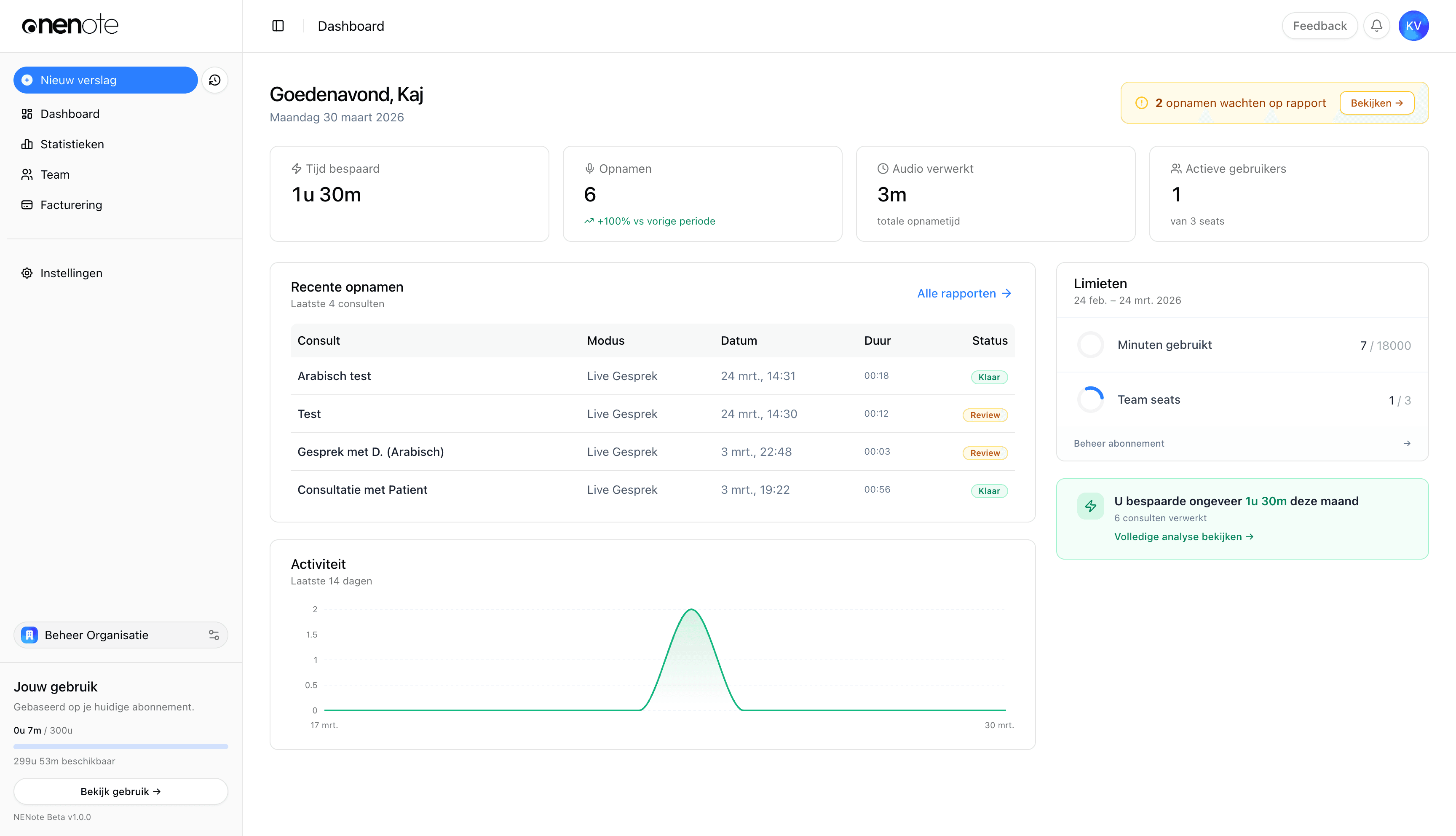
NENote is a SaaS platform with three distinct layers: the consultation session interface, the report editing environment, and the team management dashboard.
Clinicians use the session layer during or between patient encounters. They start a recording, conduct the consultation as normal, and receive a structured report when the session ends. The report is fully editable before it is saved or copied into any EPD system.
Practice managers and team leads use the dashboard layer to oversee report status, manage templates, control user access, and track efficiency across the team.
The platform is EPD-agnostic by design. Output is structured, clean, and ready to paste into Nedap, ChipSoft, Medicom, or any other system. No direct integration required (to be integrated), no dependency on third-party APIs the practice doesn't control.
Product & System Design
The core design challenge was one of trust. Medical professionals are accountable for every word in a clinical record. Introducing AI into that process means the interface must be completely transparent about what the AI produced, what was edited, and what the clinician approved.
Every design decision follows from that principle.
Reports are presented with the AI-generated draft clearly marked. The clinician reads, adjusts, and confirms. Nothing is saved without that step. The UI makes the review process feel natural.
The information hierarchy is built around the clinical workflow. The recording controls are minimal and unobtrusive. The structured output is readable at a glance. The editing layer behaves like a focused document editor.
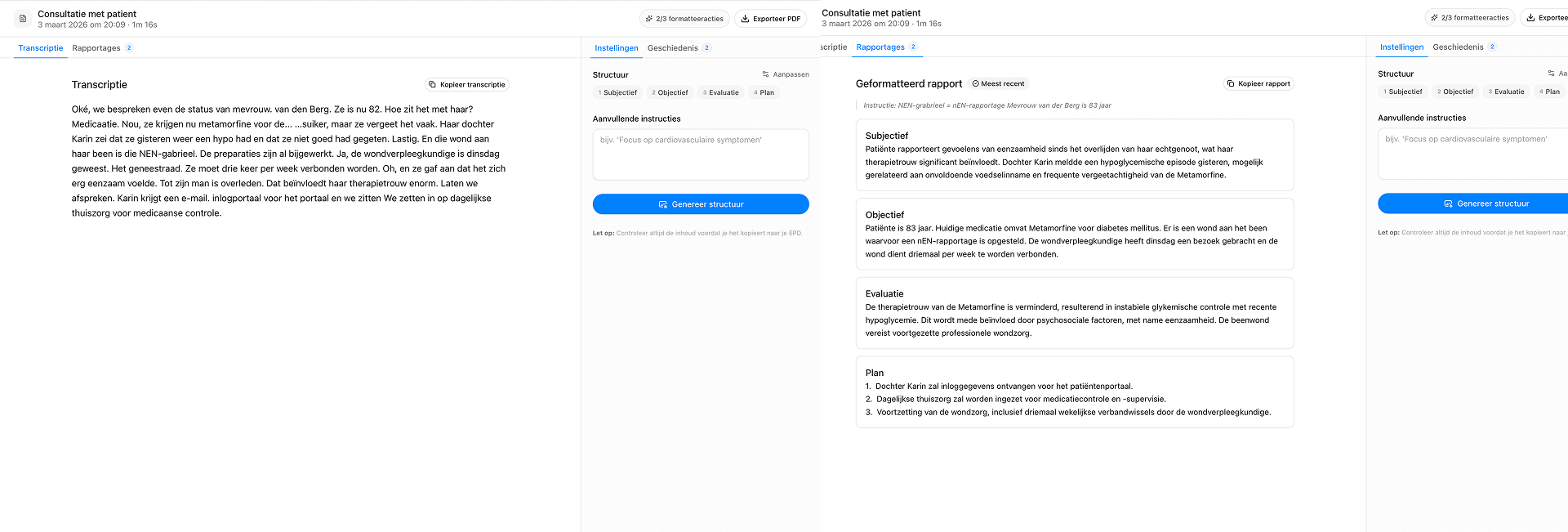
Complexity lives in the system. The SOEP structuring logic, the language model routing, the compliance layer, it all runs behind a surface that a clinician can start using in minutes.
Experience Highlights
The session interface is designed to disappear. A clinician starts a recording with a single action and conducts the consultation without needing to look at the screen. NENote processes audio in real time, handles background noise, recognizes entities and sentiment and maintains accuracy above 95% across Dutch medical vocabulary and dialect variation.
The interaction model is deliberately passive. Although the clinician can make notes, they are never prompted to correct, adjust, or annotate during the session. That happens after, in a distraction-free editing environment.
SOEP structuring and custom templates
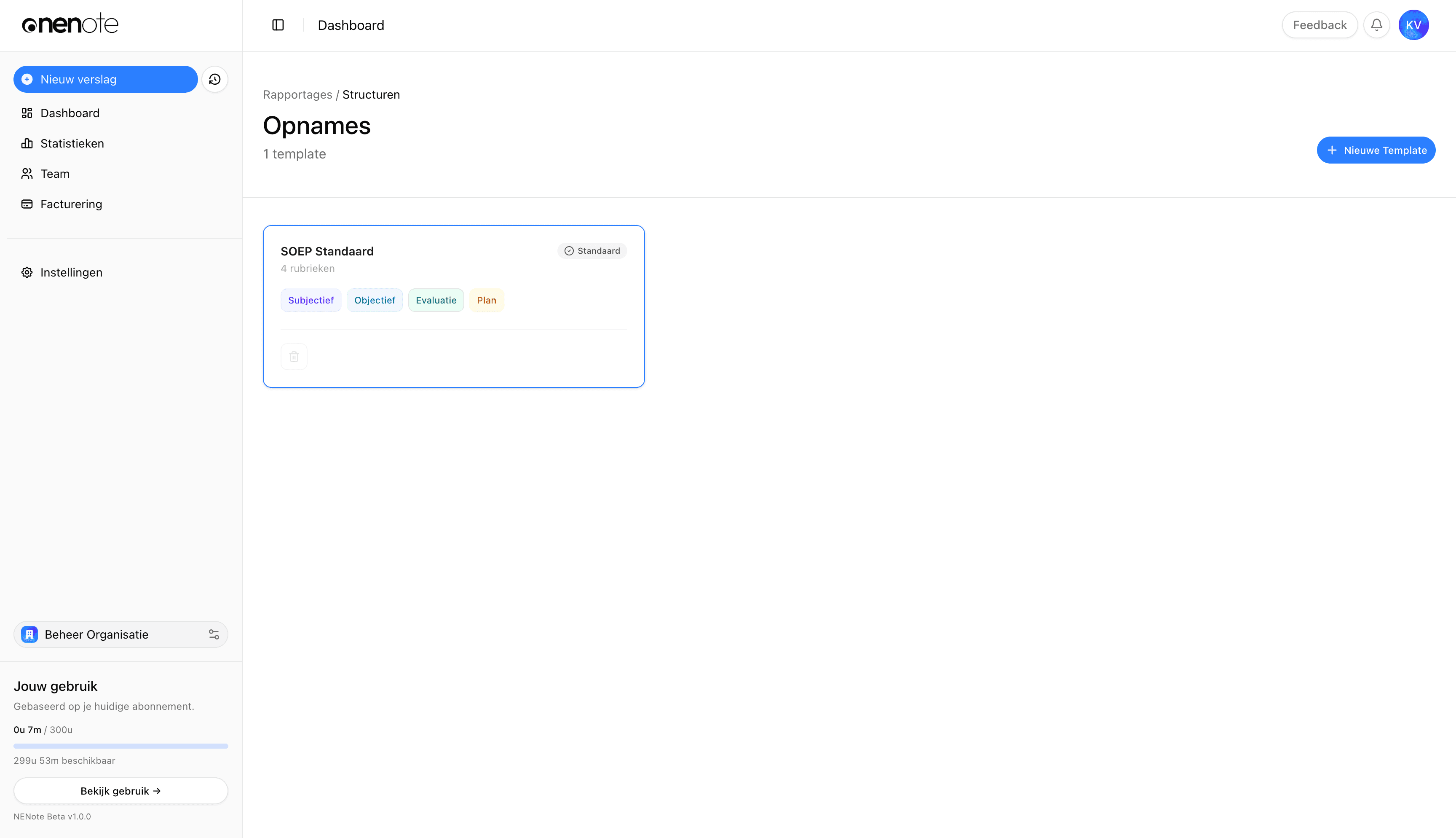
Once a session ends, NENote structures the transcript into a clinical report. The default format is SOEP: Subjective, Objective, Evaluation, Plan. This is the standard used across Dutch primary and specialist care.
Practices can define their own templates for specific specialisations or workflows., since a GGZ team and a cardiology outpatient clinic have different documentation requirements.
Multilingual interpreter mode
A significant share of consultations in the Netherlands involve patients who don't speak Dutch. Professional interpreters cost between €75 and €150 per session. NENote's interpreter mode removes that dependency for documentation purposes.
The platform supports 100+ languages. A consultation conducted in Arabic, Turkish, or Moroccan Darija is processed and delivered as a structured Dutch clinical report at the same quality as a Dutch-language session.
Team dashboard and role management
For practices with multiple clinicians, the team dashboard provides a centralised view of all session activity: which reports are complete, which are pending review, and where time is being saved across the team.
Practice managers can assign roles, manage shared template libraries, and monitor usage per seat. The interface is built for operations.
Visual / UI Direction
The interface is clinical in the literal sense. Precise, uncluttered, and purposeful. No decorative elements. No feature-heavy sidebars. The visual language is built to reflect the environment it is used in.
Typography is set in a clean sans-serif with strong hierarchy between headings, labels, and body copy. Spacing is generous. Interactive elements are large and confident. The product is frequently used on tablets in clinical settings.
The colour system uses neutral tones as the base with a restrained accent palette for status indicators: active sessions, pending reviews, confirmed records. The goal is immediate legibility, not visual complexity.
Compliance by Architecture
NENote is built for the Dutch regulatory environment. Data is processed and stored within the EU without exception. The platform is compliant with GDPR, NEN 7510, and NEN 7513, including full audit trail support.
The zero-training policy is structural: patient conversations are never used to improve or retrain AI models. The data belongs to the practice.
For enterprise clients, the platform supports SAML SSO, role-based access control, and DPIA documentation. Ready for procurement processes at larger healthcare organisations without additional configuration.
A project by The North Solution
Contact us